
Reviewed · BIKE & SEGWAY TOURS
The Original ‘Creole and Crescent’ Bike Tour
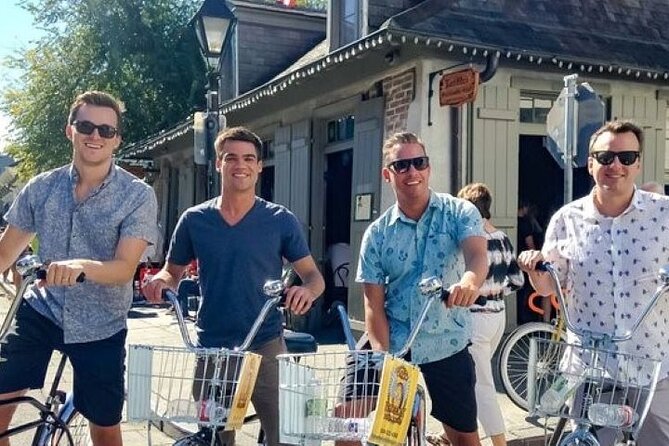
Jazz begins on two wheels. The Original Creole and Crescent Bike Tour pairs a smooth ride with real neighborhood stories, starting right in the French Quarter at FreeWheelin’ on Burgundy Street and reaching deep into Treme. I like that it’s run by a company with staying power since 2011, not a fly-by-night setup, and I like that the route isn’t stuck in the usual postcard loop.
You get a guided mix of big-sky scenery and close-up history: live oaks, bayou views, and stop-and-start moments for photos and context. It’s also built to be fun in the way a good local guide is fun—moving with purpose, joking when it fits, and keeping you pointed the right direction.
One thing to plan for: this is a bike tour. If you can’t ride confidently or you’re not up for a moderate effort over a couple hours, you’ll be happier choosing a walking or carriage-style option instead.
In This Review
- Key points at a glance
- From French Quarter basics to Treme reality
- Price and what you get for $55 per person
- How the ride actually flows: Esplanade to City Park to Bayou
- Stop 1: French Quarter start point
- Stop 2: Esplanade Avenue and Gayerre Place
- Stop 3: Frenchmen Street (a quick hit)
- Stop 4: City Park live oak country
- Stop 5: Bayou St. John along the water
- The stops that make it stick: Treme, Congo Square, and the cemetery pause
- Stop 6: Treme with real neighborhood access
- Stop 7: St. Louis Cemetery No. 3 (brief, not a full tour)
- Stop 8: Congo Square to connect the dots
- Stop 10: Louis Armstrong Park (quiet finishing energy)
- Guides, safety, and why group size stays small
- Timing, comfort, and what to bring (so you don’t regret it later)
- Expect frequent “look and listen” breaks
- Rain doesn’t have to ruin it
- Dress for biking, not for photos
- Who should book this bike tour (and who should skip it)
- Should you book the Original Creole and Crescent Bike Tour?
- FAQ
- How long is the Creole and Crescent bike tour?
- Where do we meet, and where does the tour end?
- What is included in the ticket price?
- What should I bring or wear?
- Is this tour good for first-time visitors to New Orleans?
- Do you enter the cemetery during the stop at St. Louis Cemetery No. 3?
- How big is the group?
- What happens if the weather is bad?
- What is the cancellation policy?
Key points at a glance
- A company with real track record: founded in 2011, 13 years in business, and 3,000+ five-star reviews across platforms
- Smart route that goes beyond the Quarter: you’ll ride past Millionaires Row, through City Park, along Bayou St. John, and into Treme
- Short, story-focused stops: each moment is brief, but packed with names, places, and what to look for
- Practical touring gear included: helmet, water, handlebar bag, bell, and ponchos if weather turns
- A safety-first guide vibe: guides like Teddy and Laura are repeatedly described as friendly, funny, and safety-minded
- You don’t get a full cemetery tour: St. Louis Cemetery No. 3 is a brief stop for stories and photos, not a guided inside walkthrough
More of New Orleans on two wheels
- New Orleans French Quarter and Garden District Bike Tour★ 5.0 · 410 reviews
- New Orleans Creole Odyssey Small-Group Bike Tour★ 5.0 · 268 reviews
- Creole New Orleans Electric Bike Tour (ages 16 & up)★ 5.0 · 230 reviews
- New Orleans History and Sightseeing Small-Group Bike Tour★ 5.0 · 215 reviews
From French Quarter basics to Treme reality
If your New Orleans plan is mostly about food and music, a bike tour can still be the best way to get your bearings fast. This one starts at 317 Burgundy St, at the FreeWheelin’ shop in the French Quarter. That matters. You’re not spending your vacation figuring out where to meet a vague pickup point or wandering around looking for a tour that doesn’t exist.
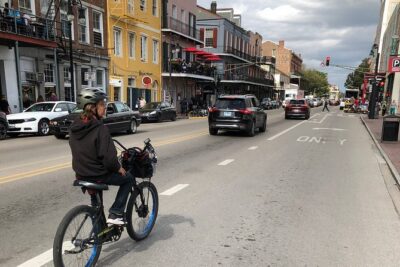
Then the tour expands your map in a way most short tours can’t. You begin with the classic French Quarter energy, but you don’t stay trapped in it. You roll out onto Esplanade Avenue (known locally as a historic Creole corridor), and soon you’re trading street-level buzz for big-tree shade and bayou scenery. By the time you’re in Treme, the tour feels like it has shifted from sightseeing to understanding neighborhoods.
And that’s where the “Creole and Crescent” idea earns its name. You’re not just riding a straight line. You’re tracing settlement-era New Orleans along a route that connects the French Quarter area to places like Bayou St. John and Treme—key neighborhoods that shape how the city actually works.
Price and what you get for $55 per person
At $55 per person, this isn’t a bargain-kicker, but it’s also not one of those New Orleans “pay a lot, stop for one photo” experiences. For that price, you’re getting:
- A bicycle provided for you
- Bottled water during the ride
- Helmet, plus a handlebar bag and bell (so you’re not improvising)
- Ponchos included for rainy weather
That package matters more than it sounds, especially in a city where weather can swing fast. If you show up with only sneakers and optimism, you’ll still be fine.
You’re also paying for local guidance. This company started in 2011 and emphasizes that it’s built on real guides and an actual operating setup—not something run informally. With original owner and original guides, the pitch is consistent: you’re going to hear stories from people who know the neighborhoods, not just read off a script.
How the ride actually flows: Esplanade to City Park to Bayou
This tour is paced for two things: staying relaxed enough to enjoy and staying quick enough that you don’t feel stuck in traffic for hours. Expect around 2 to 3 hours total.
Stop 1: French Quarter start point
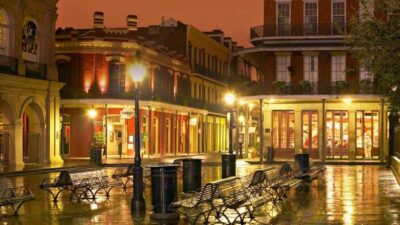
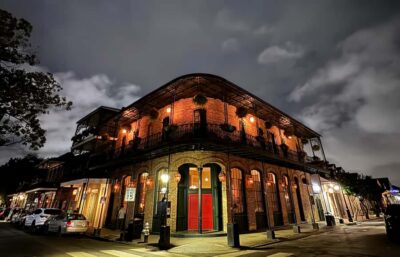
You meet at the FreeWheelin’ shop at 317 Burgundy St. From there, you set the tone with a French Quarter introduction—enough context to help you read the buildings and street layout as you move.
If you’re short on time, this is a strong way to begin your day. You’re starting with the city’s famous core and immediately turning it into something navigable.
More rides through the neighborhoods



Stop 2: Esplanade Avenue and Gayerre Place
This is the “Millionaires Row” stretch—about 4+ miles—and it’s one of the best places on the route to learn how social power shaped architecture. You’ll pass grand homes tied to the city’s Creole aristocracy, and you’ll get the kind of details that make you look twice at features you’d otherwise ignore.
One of the named moments here is Gayerre Place, where you’ll see the decorative monument titled Peace, the Genius of History. Even if you’re not a statue person, this is the type of stop that gives you a reference point for the rest of the walk-and-ride.
Stop 3: Frenchmen Street (a quick hit)
Frenchmen Street is a short stop—just a moment to catch the vibe of New Orleans live music culture. It’s brief, but it helps you contrast it with the louder Bourbon Street area without having to overdo the late-night energy if you’re riding earlier in the day.
Stop 4: City Park live oak country
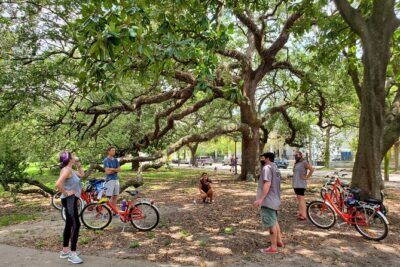
City Park is where the tour gets a little more cinematic. You ride through a grove of live oaks, then stop to hear stories tied to duels and tragedy that took place there.
This is also where the environment shifts: the ride feels less like hustling through neighborhoods and more like moving through a landscaped refuge. If you’re coming from the tight streets of the French Quarter, this part gives your body a break and your brain a chance to absorb.
At the end of the park section, you cross Magnolia Bridge and angle toward Treme.
Stop 5: Bayou St. John along the water
Then you ride along Bayou St. John for a while. The bayou stretch gives you a different angle on New Orleans—less postcard, more lived-in and local.
You also make a stop on Ursuline Avenue, lined with live oaks, for another history lesson in a setting that feels made for slowing down. This is a good moment if you want to stop cycling and simply look around.
The stops that make it stick: Treme, Congo Square, and the cemetery pause
Some tours do “history” by listing dates. This one tends to do it by pointing to places and explaining why those places mattered. The result: you remember what you saw.
Stop 6: Treme with real neighborhood access
You go deep into Treme, and that’s a meaningful difference from tours that only skim the edge. You’re not just riding past. You’re rolling into the neighborhood with time built in—plus the promise of warm welcomes from people in the area.
The vibe you’re looking for here is obvious: smiles, waves, and a friendly New Orleans greeting as you ride toward Armstrong Park and Congo Square.
If you’ve seen Treme only through TV-style portrayals, this is where you recalibrate. Even if you don’t chat with anyone, the streets, the pace, and the everyday details help you understand the neighborhood as a living place, not a theme set.
Stop 7: St. Louis Cemetery No. 3 (brief, not a full tour)
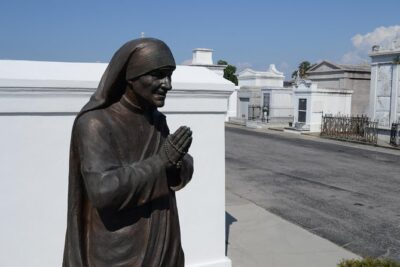
You stop at St. Louis Cemetery No. 3, described as the last and oldest of the St. Louis cemeteries. But the important part: this isn’t positioned as a full cemetery tour. It’s a short story stop with a chance for photos and a small stroll among the tombs.
You’ll hear about the burial process for deceased New Orleanians. It’s short, but it’s the kind of context that turns a cemetery stop from creepy curiosity into meaningful cultural understanding.
Stop 8: Congo Square to connect the dots
This is your wrap-up zone. Congo Square is treated as the place where things come together—called the birthplace of jazz music and tied to the origins of Jazz Fest.
Even with the short time, the stop matters because it ties your whole ride into one idea: New Orleans music culture didn’t appear out of nowhere. It has roots in specific spaces, people, and traditions.
Stop 10: Louis Armstrong Park (quiet finishing energy)
You also pass through Louis Armstrong Park toward the end. The ride through the park is described as peaceful, with fountain-filled ponds and tree-lined paths. It’s a nice final reset—like the city letting your legs cool down before you finish near Congo Square again.
Guides, safety, and why group size stays small
This tour runs with a maximum of 12 travelers, which is a big deal in a city where bike lanes are inconsistent. Smaller groups tend to move more smoothly through tight spots and make it easier for the guide to keep an eye on everyone.
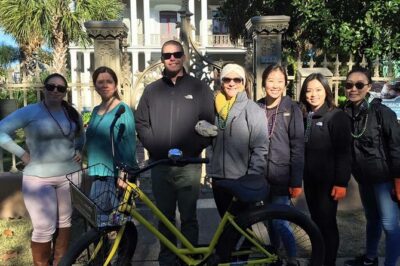
Safety is part of the guide culture here. In the feedback, guides such as Teddy and Laura are repeatedly described as friendly, funny, and focused on keeping the group moving safely. You’ll also notice that the included gear helps: helmets are provided, and you get a handlebar bag and bell so you aren’t juggling everything in your hands.
Also: the ride is described as requiring moderate physical fitness, and it’s not recommended if you can’t ride a bike. That’s not a “maybe.” If riding is shaky for you, pick a different format. This is a tour where confidence matters more than athletic training.
Timing, comfort, and what to bring (so you don’t regret it later)
The tour is 2 to 3 hours, and it’s scheduled to match the route’s rhythm: short stops, then back to rolling.
Expect frequent “look and listen” breaks
Many stops are listed as around 10 to 20 minutes, which means you’ll spend more time moving than waiting, but you won’t feel like you’re sprinting. If you want a slow meander with long explanations at every stop, you might feel like it’s over quickly. One theme from the feedback is that people wished for a bit more time and a few more stops.
The fix is simple: do this tour earlier in your trip, then go back later on foot to the places that grabbed you.
Rain doesn’t have to ruin it
Ponchos are included for rainy weather. So you can dress for comfort and plan to keep going.
Dress for biking, not for photos
The tour includes a helmet and a handlebar bag, but you still want your clothing and shoes to handle cycling—no loose, hard-to-control slips and no footwear that’s painful on the pedals. You don’t need special gear, just basic bike sense.
Who should book this bike tour (and who should skip it)
This is a great choice if you want:
- A guided overview of key New Orleans neighborhoods without doing a giant day-long tour
- A route that mixes major landmarks and real local areas
- A fun guide style—history with jokes, not history with lecturing
- Included basics that reduce your packing pressure
It’s especially well-suited if you’re traveling with a mix of ages, since the tour is described as accommodating (with guides being responsive to different riders). But there’s one hard boundary: if someone in your group cannot ride a bike, this isn’t the right option.
If you’re the kind of traveler who hates riding near traffic or who needs a slow walking pace for mobility reasons, consider an alternative New Orleans tour format.
Should you book the Original Creole and Crescent Bike Tour?
If your goal is to get a smart, local-feeling sweep of New Orleans in a couple hours, I think this is a strong booking. The value is solid: $55 gets you a bike, helmet, water, ponchos, and a guide-driven route that covers far more than the French Quarter alone.
Book it when:
- You want neighborhoods like Treme and Bayou St. John on your map
- You like short story stops tied to actual places
- You’re comfortable riding for a couple hours
Skip or reconsider if:
- You can’t ride confidently
- You need lots of downtime and walking breaks
- You’re looking for a super long, stop-every-corner style experience
FAQ
How long is the Creole and Crescent bike tour?
It lasts about 2 to 3 hours.
Where do we meet, and where does the tour end?
You meet at FreeWheelin’ Bike Tours & Rentals, 317 Burgundy St, New Orleans. The tour ends back at the meeting point.
What is included in the ticket price?
You get a bicycle, bottled water, a helmet, a handlebar bag, a bell, and complementary ponchos for rainy weather.
What should I bring or wear?
Bring basic bike-ready clothing and shoes since the tour is moderate fitness and you must be able to ride a bike. Ponchos are provided if it rains.
Is this tour good for first-time visitors to New Orleans?
Yes. It starts in the French Quarter and then expands into key neighborhoods like Bayou St. John and Treme, plus stops at places tied to music history.
Do you enter the cemetery during the stop at St. Louis Cemetery No. 3?
You don’t get a full cemetery tour. It’s a brief stop for stories, a photo op, and a short stroll among the tombs.
How big is the group?
There’s a maximum of 12 travelers.
What happens if the weather is bad?
This experience requires good weather. If it’s canceled due to poor weather, you’ll be offered a different date or a full refund.
What is the cancellation policy?
It’s listed as non-refundable and cannot be changed for any reason.
More Tours in New Orleans


More Tour Reviews in New Orleans
More Two-Wheel New Orleans


Just added to The New Orleans Traveler


Bike & Segway Tours, compared.
 ★ 5.0French Quarter and Garden District Bike TourFrom $55410 reviews
 ★ 5.0Creole Odyssey Small-Group Bike TourFrom $55268 reviews
 ★ 5.0Creole New Orleans Electric Bike Tour (ages 16 & up)From $89230 reviews
 ★ 5.0History and Sightseeing Small-Group Bike TourFrom $55215 reviews
 ★ 5.0Heart of the City Bicycle TourFrom $55202 reviews
 ★ 5.0Garden District and Cemetery Bike TourFrom $55187 reviews
 ★ 5.0French Quarter Historical Segway TourFrom $81178 reviews
 ★ 5.0City Bike TourFrom $60162 reviews
Browse the lists this tour appears in